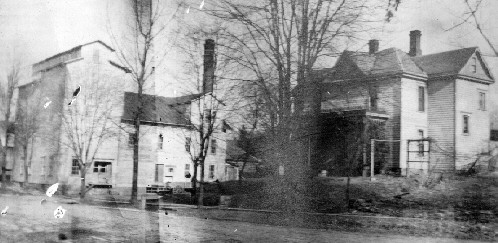
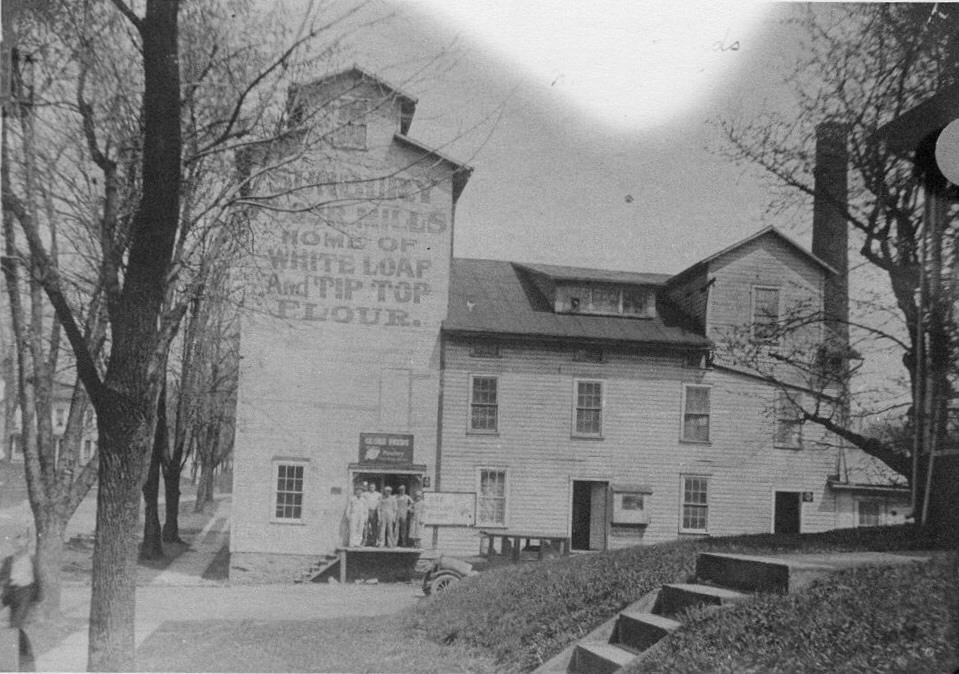
Burrer Mill and Home at 46 North Columbus, circa 1909
Burrer Mill
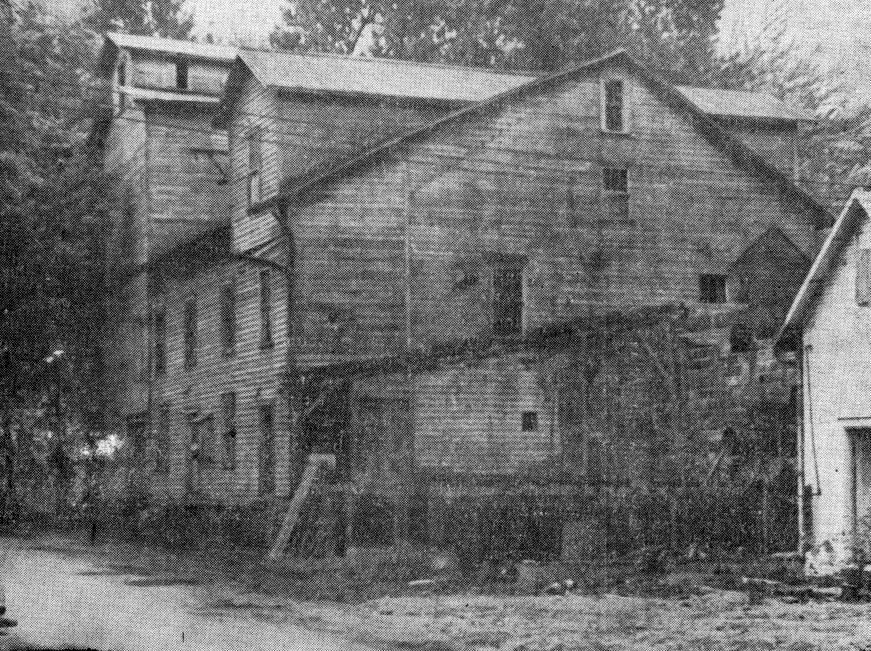
Shrive Gammill kept his promise and built the Burrer Mill at 60 N. Columbus Street. Foundations were laid for a frame structure for the mill and one of stone for the boiler and engine room. Since the new mill was to burn the excess slabs and saw-dust from Gammill’s saw mill and Hoop Factory to fire the new boiler, an exceptionally large and tall smoke stack was erected to permit burning of this fuel with safety in the quantities needed.
A steam engine was purchased in Mt. Vernon shipped by train to the trestle over the Big Walnut but the trestle was being replaced from its collapse. The machinery was loaded onto a wagon and pulled by ox to the mill.
In the new Sunbury Mill, grain was ground between rotating grooved stones or ‘buhrs’ made in France, cut in segments, shipped to Sunbury, put together with wide bands of thick steel. In 1996 one of these was preserved in the patio of Jakie’s home at 46 N. Columbus Street. Its mate was in custody of R. F. Sherfy who lived near the Big Walnut Creek east of Sunbury.
In 1879, Jakie and his wife Amy transferred the deed to the old Burrer (Bailey, Boyd) Mill to Jakie's sister Louisa and her husband Henry Fleckner where it became part of the quarry. Fleckners built their house at 10 Walnut Street where they raised two children. Some of the old stone foundation of the mill can be seen near the creek. In 2016, Dan Schwartz is restoring the house.
Jakie and Amy became the parents of 5 boys: Sprague who was named after Jakie’s former partner was born in 1876, Karl in1879, Parker in1886, Rudolph in 1888 and Gordon in 1894.
Sprague Burrer, oldest boy was 10 when he was playing with two of his brothers and two of his cousins and was caught in the mill machinery and carried to the top of the mill and back to the basement 4 times before the father and uncle could stop the machinery and free the child. Sprague lost both feet and his life that afternoon. The other four boys grew to adults at the mill. Knowing the perils of childhood around such a mass of unprotected drive belts, pulleys, sprockets, gears, clutches, engine fly-wheels, rotating, shaking and reciprocating machinery, it is indeed a miracle that all of the other boys were not injured
Sunbury Mill flourished. Farmers brought their grain from miles around by wagon or horseback and often had to wait hours for their turn to get the grain. Amy Burrer was not a great cook but she was still expected to feed farmers waiting for their grain to be milled. She served pancakes from flour ground at the mill. When she was stressed or busy whether doing laundry or calling on new people in town, Amy cooked beans. She became known for both but many people remembered her for being frugal.
Coal was delivered to houses and businesses and sent down chutes into the basements. Amy timed her walks to follow the deliveries. This gave her the opportunity to pick up coal dropped by the delivery men, put it in her purse and take it home to add to the family’s coal supply. But to Louise Sheets, Aunt Amy Burrer was very special. Each summer Louise came over the corduroy road from Delaware to spend a week visiting her Aunt Amy. Since Amy had only boys, she was delighted to have the little girl. She took Louise shopping which was a special treat because her mother made all her clothes. As an adult, Louise Sheets owned The Little Shoppe which was an upscale dress shop at 14 South Vernon Street north of the Drug Store. She also sold Hummel figurines and prints.
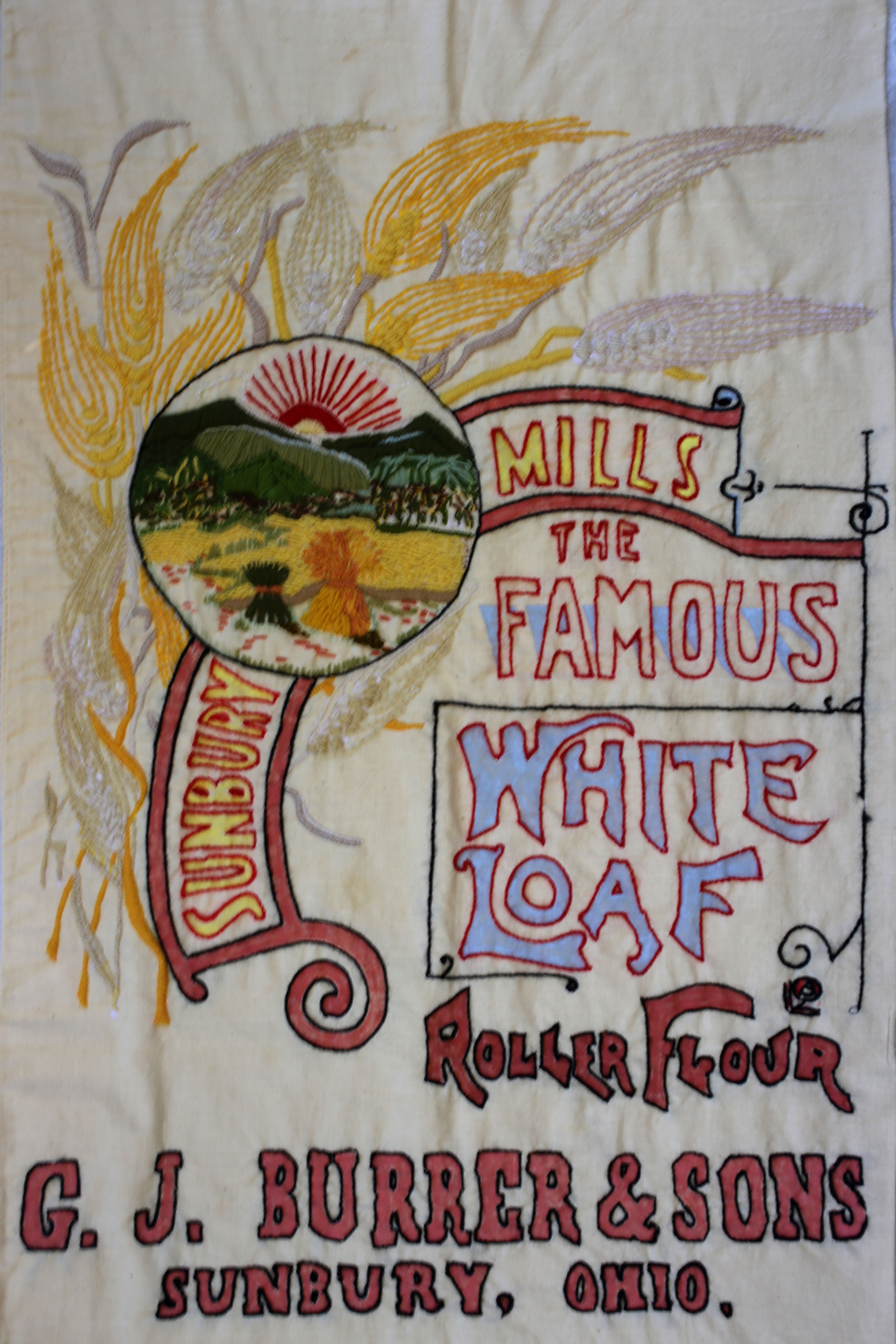
The stone buhrs were replaced with steel rollers in 1886 and the Sunbury Mill was known for its white loaf flour and Red-A-Mix pancake flour. This was shipped locally and overseas. During World War I Herbert Hoover’s Belgium War Relief needed flour so G. J. Burrer and Sons sent White Loaf Flour to Europe in sturdy white linen bags. The bags were stamped with the logo for the mill in bright colors.
In Charleroi, Belgium, Alice Gugenmeim’s family had a warehouse of embroidery thread which had been used by the embroidery workers prior to the war. Because of the war there was no material to embroider and the workers were out of business. She could find no bleach to remove the writing on the flour sacks but the fabric was good and strong. Women began enhancing the designs which were used to cover lampshades, waste baskets, tea cozies, pillow covers and even school smocks. The items were sold on a prominent street in Brussels and yielded tens of thousands of gold-standard francs to the Belgium Relief. In appreciation some of the school children embroidered 500 of the bags and sent them to Herbert Hoover. One of the enhanced Sunbury Mill bags was put on display in the Hoover Peace Tower. A replica is in the Community Library files.
Margaret Arnold of Community Library
for sharing a photo of the Flour Sack
In April 1945 the mill and Sunbury and Condit elevators were sold to the Farm Bureau. Forest Canady bought the Burrer Mill from the Farm Bureau. Hoyt and O.W. Whitney, jr. bought the property in 1951 and tore down the building. The Cream Corner was built on that corner and a commercial building which now houses Ke-Wa-Pa was built on the north part of the lot.
. . . .And Now You
Know
by Polly Horn
Burrer, Dorothy Dillenbeck and Horn, Polly Whitney Brehm. Flashback: A Story of Two Families. Community Library, 1996.
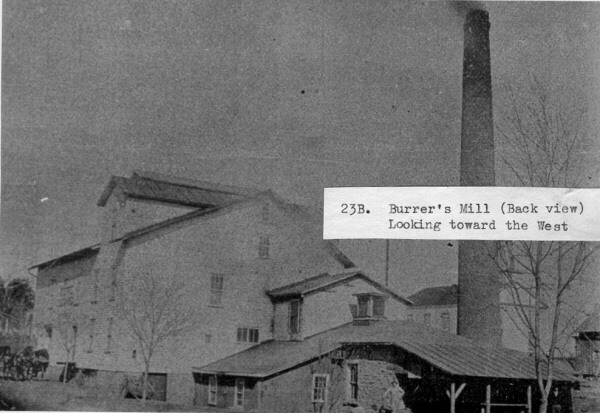
Rear View
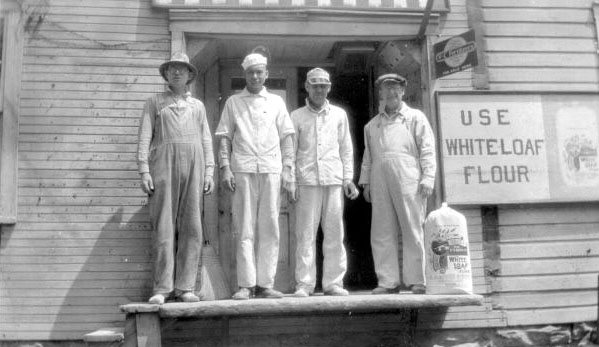
Parker Burrer, 2nd from right - 10-1911
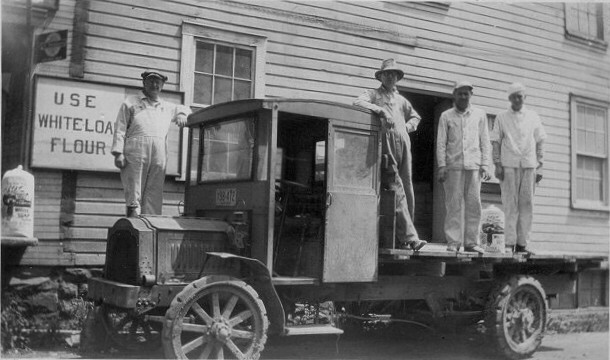
Packard Truck
2 1/2 ton,
4 cylinder
Steel Cab with sliding door
Solid Rubber Wheels
Made in Columbus
left to right
Charles Draper
Marion Parks
Jesse Doane
K.O. Burrer
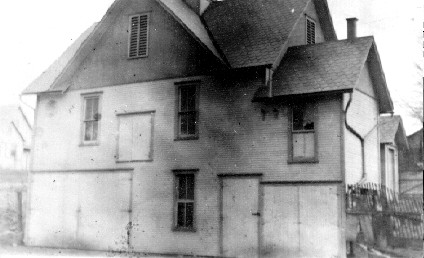
Burrer Barn
on north side
of North
Street used
to store grain
Goto Early Sunbury Mills and Stone Quarry
Goto Burrer Bakery
Goto Spring Fed Creeks Bring Businesses to Sunbury
(Gammill's Hoop Factory and Burrer Mill)
Goto Burrers Bring Electricity to Sunbury
Goto G. J. Burrer Company
Return to Local History Index
(03/05/2021 )